Microfluidics case study
Available (limited)Microfluidic simulation software
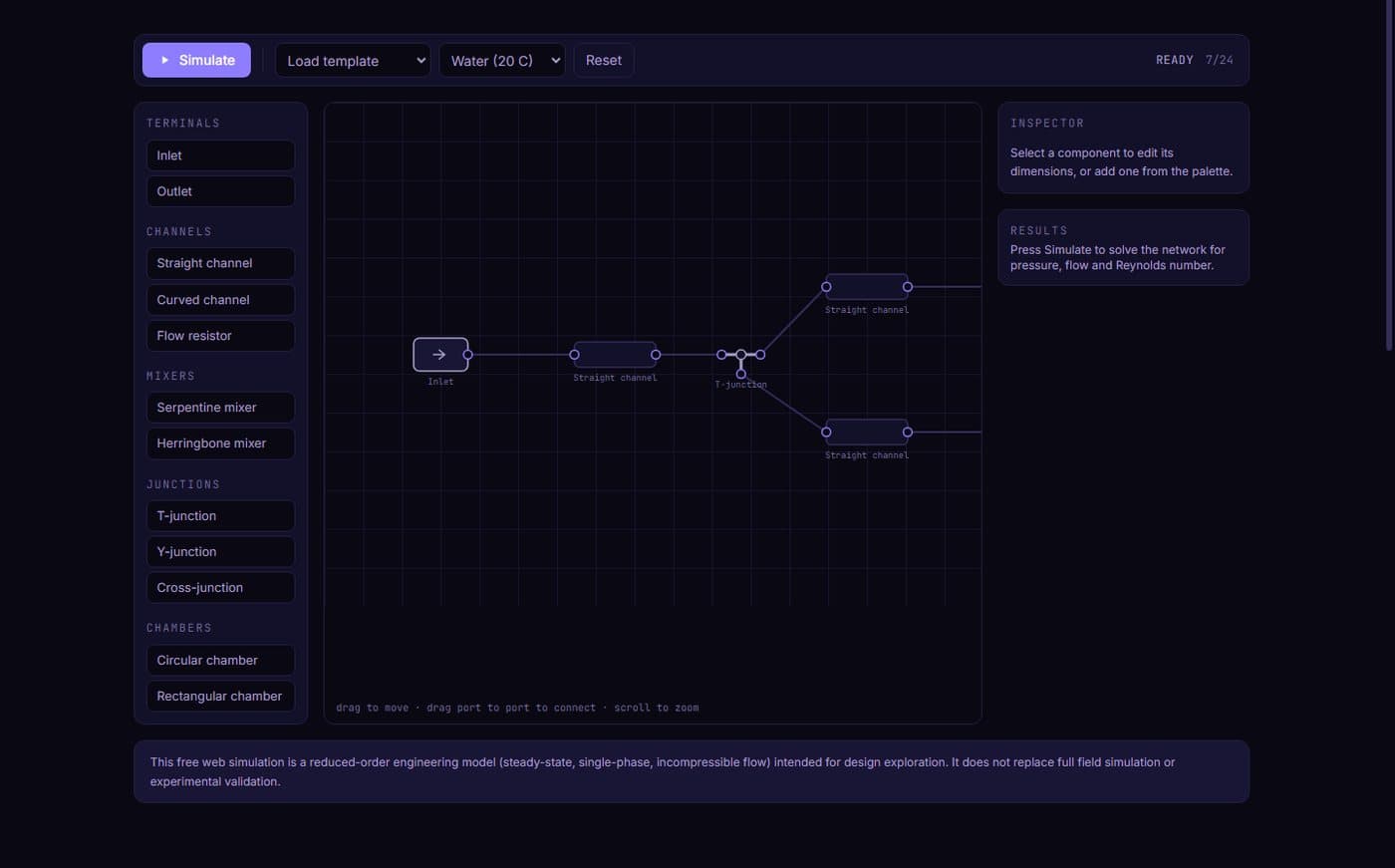
Before committing a chip to fabrication you need to know how flow distributes across it - the pressure at each node, the split between branches, the velocity and Reynolds number in each channel. Full CFD answers this but is slow and heavy for topology decisions. Octara uses a reduced-order lumped-hydraulic model that answers it in the browser, from the same formulas as the desktop application.
The problem
A microfluidic chip is a network of channels, junctions and chambers. Whether flow splits the way you intend depends on the hydraulic resistance of every channel and how they connect. Getting this wrong means unequal outlets, starved chambers or bubbles - discovered only after fabrication.
Architecture
- Each channel is a resistor (an edge) between two nodes.
- Junctions and chambers are nodes; their ports collapse to a single node.
- Inlets are flow sources; outlets set a pressure reference (ground).
- The network is solved with modified nodal analysis - a conductance Laplacian.
Assumptions
- Steady-state flow
- Single-phase, incompressible, Newtonian fluid
- Laminar regime (low Reynolds number)
- Rigid channel walls, fully-developed flow
- Entrance and minor losses neglected
Model
Rectangular-channel resistance uses the exact Fourier-series solution; the network is assembled as a conductance Laplacian and solved for the node pressures, then back-substituted for per-channel flow, velocity and Reynolds number.
R = 12 mu L / (w h^3 C), C = 1 - (192 h)/(pi^5 w) * sum_{n=1,3,5,...} tanh(n pi w / 2h) / n^5Circular channel: R = 8 mu L / (pi r^4)Network solve: G * P = q (conductance Laplacian, nodal pressures)Per channel: Q = dP / R, v = Q / A, Re = rho |v| D_h / muSimulation results
- Mass is conserved at internal nodes to near machine precision (residual ~1e-15).
- Series channels reproduce R_total = R1 + R2; parallel branches split flow inversely to resistance - both match the analytic result exactly.
- Every case is covered by unit tests; invalid networks are rejected rather than given plausible numbers.
- The solve runs instantly, client-side, with no account.
Limitations
- Reduced-order: no spatial field, mixing, diffusion, droplets, two-phase flow or inertial focusing.
- Screening-grade for topology and sizing - not a replacement for full CFD or experiment.
- The desktop application adds validated 2D/3D field solvers for those regimes.
Try it in the free Studio
Build a network like this and solve it for pressure, flow and Reynolds number in your browser - the same lumped-hydraulic model, no account needed.
More microfluidics case studies