Microfluidics case study
Available (limited)Microfluidic concentration-gradient generator
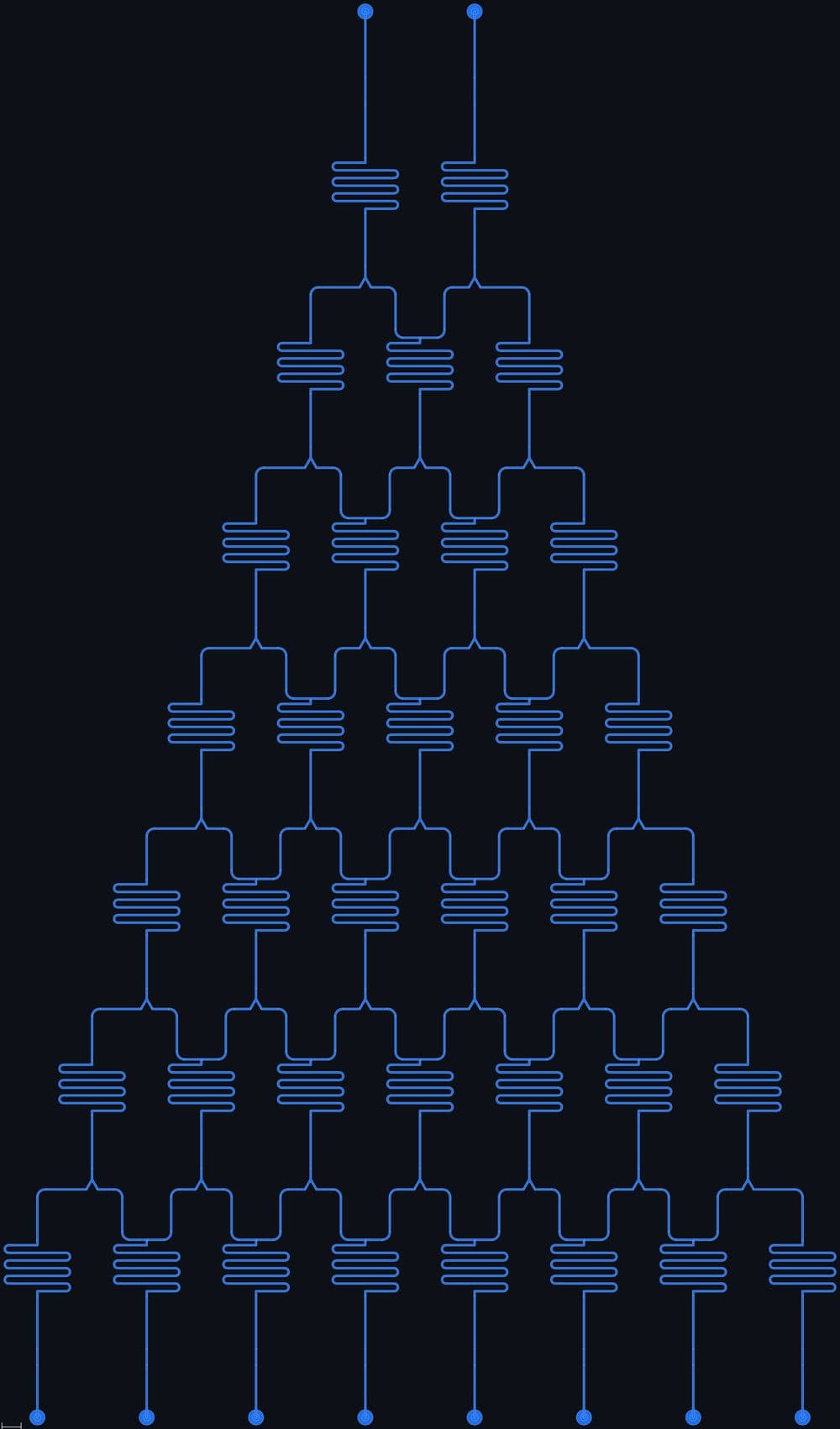
Dose-response, chemotaxis and screening assays need defined, repeatable concentration gradients across parallel channels. The classic solution is the Christmas-tree, or Pascal-triangle, network: a cascade of split-and-mix stages that produces a graded set of concentrations at the outlets.
The problem
The gradient is only as good as the flow balance. If branches do not carry equal flow, or streams are not fully mixed before they recombine, the outlet concentrations drift from the intended profile.
Architecture
- Repeated split-mix stages: each stage splits streams and recombines neighbours.
- Serpentine mixers between stages give diffusive mixing length.
- A collection manifold gathers the graded outlets.
- Equal flow at each split requires matched hydraulic resistance in the branches.
Assumptions
- Matched branch resistance gives equal splitting
- Complete diffusive mixing within each serpentine
- Steady, laminar flow
Model
Equal splitting is a hydraulic-resistance condition; the outlet profile follows the binomial (Pascal-triangle) coefficients; the serpentine length is set by the Peclet-scaled mixing length so streams fully mix before recombining.
Equal split condition: R_branch equal, with R = 12 mu L / (w h^3 C)Outlet weights follow Pascal-triangle (binomial) coefficientsMixing length: L_mix ~ (w^2 U) / D (Peclet Pe = U w / D)Simulation results
- Balanced flow across N outlets when branch resistances are matched - confirmed by the lumped solver.
- A near-linear concentration gradient across the outlet channels.
- The whole network is editable and re-simulatable as you change channel widths and lengths.
Limitations
- Gradient linearity depends on complete mixing and matched resistance.
- Fabrication tolerance shifts the split - verify with a dye before biology.
- Diffusion coefficients are assay-specific; the mixing length is an estimate.
Try it in the free Studio
Build a network like this and solve it for pressure, flow and Reynolds number in your browser - the same lumped-hydraulic model, no account needed.
More microfluidics case studies